From the blog
Beauty Brand Website CMS Ingredient Transparency: What To Demand From Your Beauty Brand Website Designer

There is a small, quiet gap on every beauty PDP, and it is where most sales die. On one side of the gap is the INCI list - the legal, alphabetized, Latin-binomial ingredients deck that regulators require. On the other side is the marketing copy: "calming," "barrier-loving," "clinically tested." A buyer reads the marketing, scrolls to the INCI, sees Niacinamide, Tranexamic Acid, Bakuchiol, Phenoxyethanol, Caprylyl Glycol, and opens a second tab. What happens in that second tab decides whether they check out or close the cart. A beauty brand website CMS ingredient transparency strategy is how you make sure your site is the one they land on - and the kind of beauty brand website designer you hire decides whether that strategy is realistic or wishful thinking.
We have watched this on session replays for two years. The pattern is identical across serums, sunscreens, retinoids, and scalp treatments. The cart is loaded. Then the buyer pauses to verify one ingredient - often an active like bakuchiol or a preservative like phenoxyethanol - and the answer they find decides everything. Reddit threads from 2021, a competitor's blog that mentions your active as a cautionary contrast, a ChatGPT summary that pulls from whichever source ranks. None of those are selling your serum.
This post is for founders, in-house marketing leads, and formulation editors who have looked at that gap and realized the missing piece is not more campaigns. It is a content layer their current platform was never built to ship. Book a 20-minute Workspace CMS demo on a beauty tenant if you want to skip to seeing it run on your category.
The second-tab problem: what beauty buyers actually do at checkout
In our experience with DTC skincare and color brands, roughly 40-55% of high-intent PDP visitors open a secondary tab before checkout on any product with more than three actives. That is an industry-average figure, not a study citation, but it lines up with what every brand owner we onboard already suspects. The query patterns are predictable:
- "is [ingredient] safe pregnancy"
- "[ingredient] comedogenic rating"
- "[ingredient] vs [ingredient] for [concern]"
- "what percentage of [active] actually works"
- "is [preservative] bad for you"
If your brand has not published a calm, factual answer to those questions, three things will fill the vacuum: a five-year-old Reddit thread, a competitor's blog, or an LLM summary that cites whichever source has the cleanest schema. None of those sell for you. All of them shape how your brand is described the next time someone asks an AI assistant for a niacinamide recommendation.
INCI is the question. Your blog is the answer.
The INCI label is required to be honest in a way the front-of-pack rarely is. It lists every component in descending order down to 1%, then alphabetically below, with no marketing softening. Customers burned by a "clean" claim that did not match the back-of-pack have learned to trust INCI more than your hero copy. That is not a problem. It is an opening.
Brands that publish ingredient deep-dives - one post per active, plain English with the chemistry intact - turn the second-tab moment into a brand-trust moment. The query lands on your domain. The reader sees why you chose 4% niacinamide in a humectant-forward vehicle at a pH of 5.5-6.0, and that your phenoxyethanol is dosed well under the EU 1% cap. They close the tab and finish the cart. The compounding effect across an SKU library of 30-50 products and 200-400 noteworthy ingredients is what separates the brands that own their category in LLM answers from the ones who watch competitors get cited.

Why most beauty brands never write these posts (and how AI changes the math)
The reason ingredient deep-dives do not get written is not chemistry - most founders or their formulator have that covered. It is bandwidth. One careful 900-word post on tranexamic acid takes a half-day. You have 47 SKUs. Each has 8-15 noteworthy ingredients. The math does not work for a four-person team.
Workspace CMS ships an AI Blog Generator that drafts ingredient posts from a structured brief - INCI name, percentage, vehicle, target concern, mechanism, contraindications, your house position. The AI scaffolds. Your formulator truth-checks. A post that took half a day takes ninety minutes, and a quarter of work covers your full SKU library. Because the generator is tied to a Theme & Brand Voice profile - palette, type scale, logo, and AI-locked voice rules you define once - the drafts read like Vellum, not like generic GPT mush. The difference is what keeps you from spending the saved time rewriting paragraph by paragraph.
Pair that with the AI Visibility Tracker, which queries ChatGPT, Claude, Perplexity, and Gemini with prompts like "best niacinamide serum for sensitive skin," "is bakuchiol safe in pregnancy," and "vegan vitamin C serum under $60" on a weekly schedule. It reports whether your product is cited, what is being cited instead, and how the answer trends over time. If you are not in the answer, you see exactly which sources are - a ready-made content gap list. The AI Visibility Tracker deep-dive walks through how the tracker ties to Google Search Console and GA4 on the same dashboard, which is the only way to prove an LLM mention turned into a session and a session turned into an order.
What to demand from a beauty brand website designer in 2026
Most beauty founders evaluating a beauty brand website designer or cosmetics website company right now are being shown the same things: a Figma comp, a sample Shopify section, a Klaviyo integration screenshot. None of that tells you whether the team behind the build can also ship the 60th ingredient post, the COA update, or the reformulation footnote on the night a paid campaign launches. After watching dozens of beauty brands outgrow their first agency, this is the requirements list we now hand to every founder:
- A real SLA on ingredient and claim edits. When a formulator catches a wording issue on the bakuchiol PDP at 6 p.m., the change ships before the morning campaign, not in next sprint's backlog.
- An audit log that protects you. If you ever receive a regulatory letter, you need to show what claim was live, when, who approved it, and when it came down.
- Structured data controls a marketing lead can actually use. Product, Article, AggregateRating, FAQPage, BreadcrumbList - editable without a dev ticket.
- An editorial system, not a folder of Google Docs. A real pipeline from idea to scheduled publish, visible to your formulator, your editor, and your founder at once.
- A content layer that does not fight your cart. Shopify (or your subscription tool) keeps PDPs and checkout; the CMS handles ingredient library, blog, marketing pages, and SEO surface.
- A skincare marketing agency relationship that scales with the brand, not around it. Unlimited managed changes, in writing, so growth does not get capped by a per-ticket fee schedule.
That last bullet is the one that catches most founders out. The managed-change workflow Workspace CMS documents is what makes the rest of the list possible: an in-house team that ships the edit, on a contractual SLA, instead of a freelancer queue.
UNLIMITED MANAGED CHANGES
Send a ticket. We ship the change.
Every Workspace CMS plan includes unlimited managed CMS edits. Essentials ships in 4 business days. Growth ships in 2. Premium ships in 12-24 hours. No per-edit fees. No "open a Jira" overhead. Every ingredient deep-dive, every COA refresh, every reformulation footnote, every PDP claim correction, every seasonal launch landing page - describe what you need and our team builds it on your live site.
The eight Workspace CMS features that earn their keep at a beauty brand
You can scan the full features overview at your own pace. The eight we see DTC beauty brands actually use weekly:
- AI Blog Generator. Brand-voice-tuned drafts for ingredient deep-dives, routine guides, and seasonal explainers. The formulator-brief input field is the difference between a usable scaffold and another GPT paragraph nobody publishes.
- AI Visibility Tracker. Weekly digests on prompts like "best niacinamide serum," "vitamin C serum for sensitive skin," or "is phenoxyethanol bad" across ChatGPT, Claude, Perplexity, and Gemini. The dashboard sits next to GA4 and Google Search Console, not in a separate tab.
- AI Content Audit. Forty-plus issue checks per page with one-click fixes - missing schema, thin product copy, alt-tag gaps on hero shots, mismatched canonicals between the ingredient post and the relevant SKU. The marketing coordinator clears the queue in twenty minutes a week.
- Structured Data (JSON-LD) Editor. Visual editor with live validation. You fill Product + AggregateRating on the PDP, Article on the matching ingredient post, FAQPage on the routine guide, BreadcrumbList on the category page. The validator catches a malformed AggregateRating before Google ever sees it - and LLM crawlers, which lean harder on structured data than on prose, end up with a clean record to cite.
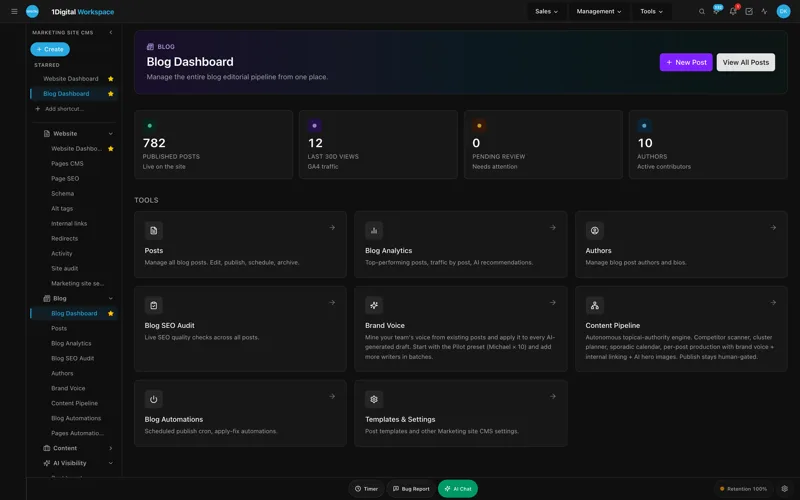
- Content Pipeline Board. An editorial kanban from idea to published. Your formulator owns "in review," your editor owns "voice pass," and the founder sees the full pipeline without scheduling a meeting. The two pieces of work that always slipped on a four-person team - sequencing ingredient posts ahead of paid launches, and not double-publishing into the same week - finally have a board to live on.
- Theme & Brand Voice. One palette, one type scale, one logo lockup, and a written voice guide the AI features actually obey. When a contractor or a new hire opens the editor, they cannot accidentally publish off-brand color or off-voice copy. For beauty brands where the visual system is the brand, this is the guardrail that keeps year three from looking like a different company than year one.
- Page Editor + SEO Sidebar. Rich-text editor with a permanent right-hand panel for title, meta, canonical, robots directives, OG image, and JSON-LD on every page. The marketing lead edits ingredient copy and meta in the same screen - no "which CMS field does that live in" tax.
- AI Meta Rewriter. Auto-generated titles and meta descriptions from the body, brand-voice-locked, with character counters built in. Running it across the back catalog the week after launch is how you turn 80 thin product pages into 80 pages Google can actually rank.
That is eight features doing actual work. Compare it to a typical "cosmetics website company" stack: Shopify theme, a meta-tag app, a separate blog platform, a third-party schema plugin, a freelance editor's Google Drive, and a designer who only opens Figma. The cost of moving information between those tools is the reason your ingredient library never gets written.
Pricing a beauty brand website CMS ingredient transparency program
The honest answer on pricing is that the right tier depends on cadence. Here is how the ladder maps to where a DTC beauty brand usually sits:
- Essentials - $89/month. Self-managed with a 4-business-day SLA on managed changes. Good if your founder or in-house copywriter is going to publish the ingredient library themselves. Includes the AI Blog Generator, 5-prompt AI Visibility tracking, the full SEO control set, and Vercel hosting. Reasonable for pre-launch or sub-$500k brands.
- Growth - $199/month. Managed by 1Digital. Most emerging beauty brands pick this. Two-business-day SLA on content edits, image swaps, and blog posts; same-business-day on blockers (a bad ingredient claim that needs to come down today, for example). 1,000 AI credits, 15-prompt AI Visibility tracking across the four major LLMs, Google reviews on your site (display and reply) for your studio or HQ, white-label admin option.
- Premium - $449/month. White-glove, 12-24 hour SLA, 4 business-hour blocker SLA, 2,500 AI credits, daily AI Content Audit, 30-prompt monthly AI Visibility digests. The right choice once you are shipping two or more posts a week and running paid traffic to PDPs where every conversion point matters.
Compare the full ladder and SLAs on the Workspace CMS pricing page. For most brands in the $500k-$5M revenue band, Growth is the floor; you move to Premium when an SLA delay starts costing real money on paid traffic.
What a 90-day ingredient-transparency rollout looks like
Weeks 1-2: launch and inventory
Workspace CMS migrates your site in the standard 2-week launch window. Your team inventories every active, vehicle, and preservative and ranks them by search volume and PDP traffic. Other beauty rollouts in the live-demo gallery show roughly the same sequence, which is useful to share with a founder or board member who wants to see the workflow before signing.
Weeks 3-8: ingredient library buildout
The AI Blog Generator drafts the top 24 ingredient posts. Your editor revises for voice and accuracy. The Content Pipeline Board queues two per week. The AI Content Audit cleans up back-catalog images and product pages so the new posts rank, and the Structured Data editor wires Product + Article + AggregateRating into a connected schema graph.
Weeks 9-12: measure and tune
AI Visibility Tracker runs weekly. The AI Content Audit flags schema gaps, broken canonicals, and unlinked ingredient mentions on PDPs. You ship fixes through the ticket queue - send a ticket; we ship the change - without touching code. Looking back at case studies from other DTC tenants at the 90-day mark is a useful sanity check that the cadence is sustainable.
Beauty Brand Website CMS Ingredient Transparency: What To FAQ
What about ingredient claims that the FDA cares about?
The AI Blog Generator drafts informational content, not drug claims. Your editorial review is where claim language gets vetted. Workspace CMS includes Owner, Editor, and Viewer roles plus a full audit log, so if a claim has to be revised after a regulatory letter, you can see exactly when it published, who approved it, and roll it back cleanly through the Page Editor.
Can I keep my Shopify checkout and use Workspace CMS for the content layer?
Yes. Most beauty brands keep Shopify (or a similar cart) for PDPs, checkout, and subscriptions, and use Workspace CMS for the marketing pages, ingredient library, blog, founder story, and SEO surface. We wire canonicals correctly so the two systems do not fight over indexation, and the Structured Data editor handles the Product schema either way.
How does the AI Visibility Tracker actually work?
It sends your prompts (for example, "best vitamin C serum under $60," "is bakuchiol safe in pregnancy," "vegan retinoid alternative") to ChatGPT, Claude, Perplexity, and Gemini on a schedule, captures the responses, and reports whether your brand is mentioned, what is being cited instead, and how the answer trends over time. It is the closest thing to a rank tracker for the LLM era, and the weekly digest lands in the same dashboard as your GA4 and Google Search Console pulls.
Do I need separate posts for each percentage variant?
No. One canonical ingredient post per active is the right structure, with internal links to the relevant SKUs at different percentages. The redirect manager with conflict detection handles URL hygiene when you consolidate older, thinner posts into the new canonical version, and the audit log records every consolidation cleanly.
What if my INCI list changes mid-quarter because of a vehicle reformulation?
Send a ticket. On the Growth tier, copy and schema updates ship within two business days; on Premium, within 12-24 hours. Real humans on the 1Digital team make the change, and the audit log records what shipped and when. No page-builder fighting, no HTML required from your side, and your AI Visibility prompts keep running through the change.
Beauty buyers will keep opening that second tab - for as long as INCI labels exist. The brands that win the next five years are the ones whose domain loads when they do, with a calm, factual, brand-voiced answer waiting. Start a conversation with the Workspace CMS team - twenty minutes, no obligation, and you will know inside the first call whether the workflow fits how your brand actually ships content.

